Importers and Distributors
Buyers creating a controlled portable cooktop assortment for appliance dealers, regional wholesalers or national distribution.
Latin America Ceramic Hob Sourcing Plan
Build a portable ceramic hob order from the exact destination, sales channel and approved product route. Compare four real catalog directions, disclose published model and wattage conflicts, then freeze the burner layout, controls, electrical identity, cookware test, Spanish or Portuguese packing, inspection and carton basis before comparing private quotations.
Wholesale only. MOQ starts from 1000 PCS. No public prices, retail orders or one-piece orders.
Buyer Qualification
Buyers creating a controlled portable cooktop assortment for appliance dealers, regional wholesalers or national distribution.
Teams requiring approved barcode, importer information, warnings, shelf-ready packing and repeat-order revision control.
OEM customers able to release logo, control text, rated label, Spanish or Portuguese manual, individual box and carton marks.
Importers combining portable cooktops with air fryers, rice cookers, blenders, electric fans or water pumps in one documented plan.
Importer Decision File
A comparable ceramic hob quotation starts with one destination and one controlled product identity. Send the country, buyer role, sales channel, single- or double-burner requirement, exact catalog route, quantity, rated-power direction, voltage, frequency, plug, cord, control style, finish, intended cookware test, packing language, destination port and trade term. The factory can then separate published evidence from open confirmation items.
Latin America is not one electrical, language or market-access version. Spanish artwork does not automatically serve Portuguese-speaking channels. Voltage, frequency, plug, cord, rated label, importer wording, warnings and applicable evidence can differ by destination. Yaoyuan Electric coordinates available factory-side options for the selected route; the importer and qualified local parties confirm destination rules, customs, tax, channel and final approval requirements.
Company / destination country / buyer channel / single or double burner / exact model or catalog route / quantity / wattage direction / voltage / frequency / plug / cord / control and finish / cookware test / artwork language / packing / destination port / trade term / warehouse-ready target.
Do not use ceramic hob, infrared cooker and induction cooker as interchangeable order names. The heating system, compatible cookware, control behavior, surface response, rated-power identity, test method and buyer explanation can differ. The purchase order, rated label, manual, box and inspection file should use the approved product identity consistently.
Before assortment approval, test the current sample with cookware selected by the buyer and record the cookware material, base diameter, flatness, load, heating observation and control setting. Do not publish a universal cookware claim without route-specific evidence. A real test file is more useful to distributors than a broad statement that every pot is suitable.
Use the ceramic hob wholesale route, single-burner route and double-burner route to define the intended product before requesting price.
The current public catalog provides two model-coded single-burner routes and two catalog-reference routes. Loading and carton figures are references from the published pages, not guaranteed quantities for a future shipment. Confirm the approved carton, order mix, loading method and current specification before purchase-order release.
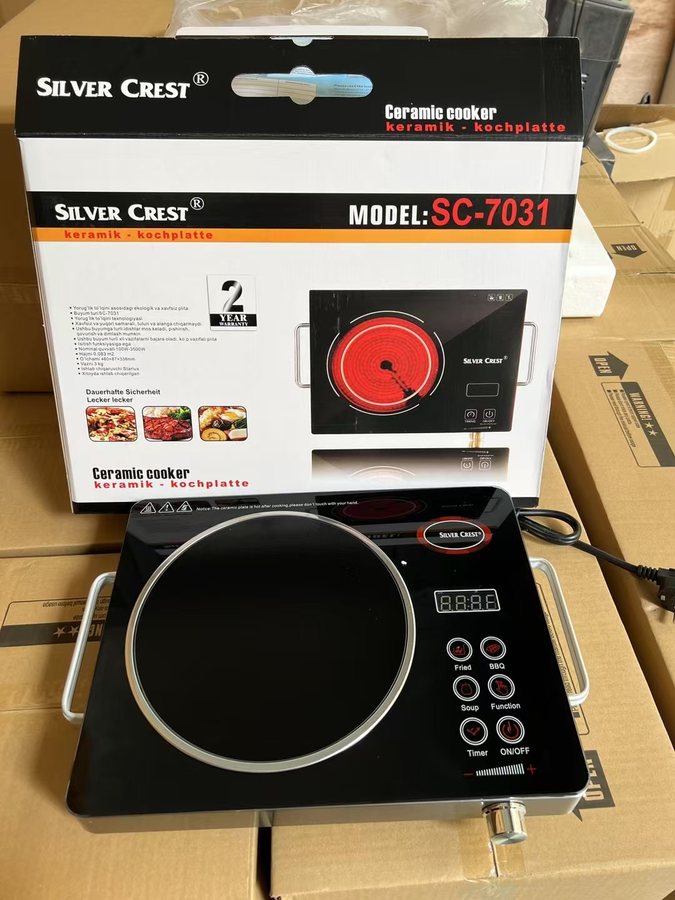
Published page fields: 2400W, AC220-240V, LCD panel, 8 units per carton and a 40HQ loading reference of 4950. The source image visibly identifies model SC-7031. Confirm control text, cookware test, plug and current packing.
Published page fields: 2400W, AC220-240V, LCD panel, 8 units per carton and a 40HQ loading reference of 4950. Keep its wood-grain finish and single-burner identity under a separate approval file.
The page does not publish a model code. Its text fields show 2400W, AC220-240V, LCD panel, 8 units per carton and a 40HQ reference of 4950; the source image visibly shows ALP-13 on the panel and 3500 watts on the box. Treat both identity and wattage as unresolved.
The page publishes no model code, wattage or voltage and lists 3 units per carton with a 40HQ reference of 1680. Its source image box visibly shows SC-7038 and 3500 watt, creating an identity conflict with the model-coded SC-7038 single-burner route.
P69 page text shows 2400W while its source image box shows 3500 watts and the product panel shows ALP-13. P70 does not publish a page model code or wattage, while its image box shows SC-7038 and 3500 watt; SC-7038 is also the published code for a separate single-burner route. These values are not silently reconciled. Request the current sample, rear label, packing image and signed specification.
A product name and exterior color do not define a complete ceramic hob. The signed file should identify the number of heating zones, rated input, voltage, frequency, heating system, control panel, display, timer, temperature or power steps, lock or safety-control direction where applicable, handles, feet, cord, plug, surface pattern, trim, housing, supplied accessories and individual packing.
For a double-burner route, record the control relationship and rated-power identity for the complete unit. Do not copy single-burner electrical or loading data into the P70 file. For wood-grain or printed surfaces, approve color, pattern placement and appearance tolerance from a current sample. For black glass routes, define the inspection lighting and acceptable appearance standard before mass production.
If a component, control board, heating element, glass, cord, plug or packing changes after approval, use the component change approval route. Record the previous reference, proposed change, reason, affected test, evidence, buyer decision and effective batch.
SC-7031, SC-7038 and P69 pages publish AC220-240V, but that does not establish the correct frequency, plug, cord, fuse, label, certification or suitability for every Latin American destination. P70 does not publish voltage on its page. Send the exact destination requirements before quotation and do not approve artwork around an assumed electrical version.
The current sample, rated label, quotation, manual, individual box and purchase order should describe the same electrical identity. If another voltage is required, request written model availability and a separate sample route. Changing voltage or plug after artwork release can affect labels, manuals, cartons, inspection and shipment documents.
Use the purchase-order checklist, supplier evidence pack and supplier onboarding checklist to keep electrical evidence connected to the commercial order.
OEM scope may include product logo, control labels, rated label, model reference, warnings, barcode, importer or distributor information, manual, individual box and master-carton marks. The buyer supplies accurate destination text, claims, barcode and importer information. The factory should not invent certification marks, performance promises, cookware claims or third-party details.
Keep Spanish and Portuguese files separate unless a bilingual route is intentionally approved. Every file should carry the product route, revision, date and approver. Compare print evidence against the final released artwork, not an earlier chat attachment. Use the OEM ceramic hob route and artwork approval workflow.
Artwork release should follow product and electrical approval. A box showing the wrong burner count, control panel, wattage or model code creates a destination receiving problem and can also repeat the source conflicts disclosed above. Maintain a release register for label, manual, box and carton files.
The sample file should identify the route, visible model code, burner count, surface, controls, electrical version, plug, cord, label, supplied parts and packing. Photograph the product front, rear label, plug, cord, control panel, glass or surface, box markings and carton. Record every unresolved difference before production release.
A written inspection scope can cover identity, surface appearance, assembly, feet and stability, handles, controls, display, indicator response, cord and plug, label, timer or lock direction where approved, heating observations under the agreed cookware and method, power-off behavior, individual packing, barcode and master-carton marks. Test method, sample size and acceptance criteria must match the order.
Use the sample order guide, pre-shipment inspection route, AQL planning guide and supplier evidence pack. The factory proof center verifies real operations, while product approval remains tied to the exact sample and order.
Compare the same route, electrical version and packing basis. A landed-cost file can include unit quotation, individual packing, units per carton, carton dimensions, net and gross weight, order quantity, inspection, inland handling, freight basis, destination charges, qualified duty and tax input, local delivery, finance and after-sales reserve.
The public pages list 8 units per carton and a 40HQ reference of 4950 for three single-burner directions, versus 3 units per carton and a 40HQ reference of 1680 for P70. Those figures require current carton confirmation. A double-burner unit should not inherit single-burner carton economics. Use the carton and CBM guide, mixed-container route and landed-cost cooperation guide.
No page guarantees freight, customs treatment, destination charges, arrival date or sales result. Keep every external input dated and identify who supplied it so the buyer can refresh the calculation before order commitment.
Send the date stock must be available in the destination warehouse. Work backward through receiving, customs and inland handling, transport, cargo handoff, loading, inspection, packing, production, sample approval, artwork release and purchase-order release. This creates a planning baseline; it is not a guaranteed vessel, clearance or sales date.
A first OEM order needs time for route clarification, electrical approval, cookware testing and artwork. A repeat order should compare the new written revision with the approved sample and previous shipment. Do not rely only on a reused model name, especially where the public source already contains model or wattage conflicts.
Use the demand and capacity route, production control guide, shipping instruction route and order risk register.
At destination, reconcile shipment identity, carton count, visible condition and sampled product identity before distribution. Record transit damage, glass or surface findings, control issues, missing parts, label differences and packing problems with photos, quantities and carton references. Separate transport damage from product findings.
Before reordering, review sellable quantity, verified service cases, return reasons, remaining stock, channel feedback and the next warehouse-ready date. Freeze the repeat-order route, electrical identity, surface, controls, artwork, carton and inspection file. Compatible service parts must be confirmed by exact route and revision, not appearance alone.
Use the receiving guide, after-sales control route, repeat-order planning guide and supplier review framework.
Public prices are not displayed because route, burner count, control system, electrical version, finish, OEM work, packing, inspection, quantity, trade term and destination change the quotation basis. Send one complete request so the sales team can prepare a comparable scope and identify unresolved evidence.
Use LATAMHOB1000 in your WhatsApp message. Wholesale only. MOQ starts from 1000 PCS. No public prices, retail orders or one-piece orders.
No assumption should be made. Confirm destination electrical identity, plug, language, labels, importer data and local requirements.
No. They are catalog references. Confirm approved cartons, units per carton, order mix, loading method and container plan.
The page text shows 2400W but its source image shows 3500 watts. Confirm the current sample, rear label and signed specification.
No such assumption is made. The P70 image shows SC-7038 while that code also identifies a separate single-burner route. Treat the identity as unresolved.
OEM packing can be discussed. The buyer supplies and approves accurate destination text, barcode and importer information.
No. Private quotation follows confirmation of route, quantity, electrical version, OEM scope, packing, timing, trade term and destination.
Wholesale Only
MOQ starts from 1000 PCS. Exact route, finish, packing and OEM scope require current confirmation.
Freeze route, burner count, controls, electrical version, surface, artwork, carton and inspection under one revision.
Send destination, language, importer information, sales channel, warehouse-ready date and destination port.
Price is prepared after route, quantity, product version, OEM scope, timing, trade term and destination inputs are fixed.
Long-Term Market Development
This route is for importers and distributors who can identify the destination country and sales channel, share target landed-cost logic, inventory and service constraints, and a repeat-order plan. Yaoyuan can coordinate the selected ceramic hob version, OEM files, supplier resources, inspection and replenishment decisions. Demand, exclusivity, delivery, sales volume and margin are not promised before both parties review the country evidence, responsibilities and commercial feasibility.
Version Evidence Before Quotation
Identify the exact model or catalog reference first. Yaoyuan can organize available sample, specification, packing and inspection evidence for that controlled version. The importer and qualified destination-market parties remain responsible for confirming applicable market-access, customs and channel requirements. This review does not promise certification, stock, delivery timing, demand, sales or profit.