Importers and Distributors
Chilean companies assigning controlled portable cooking SKUs to national, regional, dealer or online distribution.
Chile Portable Electric Hotplate Import Decision
Choose a real single- or double-burner catalog route, then freeze the product identity, electrical version, plug and cord, current SEC protocol path, Chilean Spanish sale unit, customs description, inspection and service handoff before comparing private quotations.
Wholesale only. MOQ starts from 1000 PCS. No public prices, retail orders or one-piece orders.
Buyer Qualification
Chilean companies assigning controlled portable cooking SKUs to national, regional, dealer or online distribution.
Teams that need one approved Spanish sale unit, barcode, importer data, receiving evidence and repeat-order identity.
OEM buyers prepared to approve the exact heater route, rated data, plug, label, manual, box and carton before production.
Importers coordinating ceramic hobs with air fryers, blenders, fans, rice cookers or water pumps under one Chile shipment plan.
Importer Decision File
A usable RFQ starts with the Chilean importing company or RUT identity, sales region, buyer channel and intended assortment role. Then state the burner count, exact catalog route, quantity, required rated input, voltage, frequency, plug and cord, controls, finish, cookware demonstration, Chilean Spanish artwork scope, destination port, trade term, warehouse-ready date, sample protocol, SEC questions, inspection scope and service-parts plan.
Those fields create one commercial identity that can be sampled, reviewed, quoted, documented, produced and inspected. A product photograph does not identify the heating technology. A catalog voltage does not prove another requested version. An overseas report does not automatically authorize sale in Chile. Yaoyuan Electric can organize available factory-side product records, samples, artwork, packing and production evidence. The importer and qualified Chilean parties determine mandatory certification scope, authorized certification path, Sello SEC use, tariff classification, customs, tax, consumer information and market authorization.
Importer identity / sales region / channel / single or double burner / exact catalog route / quantity / rated input / voltage / frequency / plug and cord / controls and finish / cookware demonstration / Chilean Spanish files / destination port / trade term / warehouse-ready date / SEC review questions / sample, inspection and service scope.
A compact single-burner route can support an entry, supplemental-cooking, rental-property or space-saving position. A wood-grain appearance can support a separate presentation tier. A double-burner route changes counter space, rated-input review, connection hardware, carton economics, warehouse handling and customer explanation. These are different commercial jobs, not merely different unit prices.
Record the intended channel, customer group, shelf or online presentation, target order share and replacement relationship for each SKU. If two routes have the same use, appearance, controls, electrical version and landed economics, remove one before the sample stage. A controlled range helps the distributor explain the difference, forecast replenishment and keep after-sales parts aligned with the sold version.
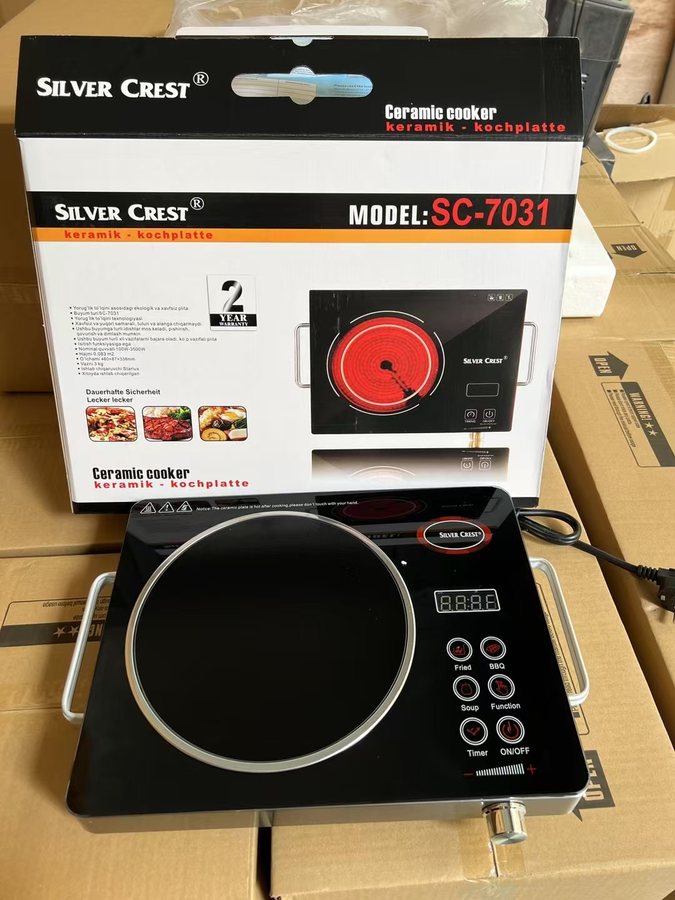
The public catalog provides two model-coded single-burner routes and two catalog-reference routes. These pages support discovery only. They do not replace a current sample, rear label, signed specification, packing sheet or Chile destination review. Published carton and loading numbers remain planning references until final packing is approved.
The public page lists 2400W, AC220-240V, LCD panel, 8 units per carton and a 40HQ reference of 4950. Confirm current controls, glass, heating observation, plug, cord, label and carton.
The public page lists 2400W, AC220-240V, LCD panel, 8 units per carton and a 40HQ reference of 4950. Keep the wood-grain appearance and single-burner construction under a separate sample release.
The page publishes no model code. Text fields show 2400W, AC220-240V, LCD panel, 8 units per carton and a 40HQ reference of 4950; source imagery visibly shows ALP-13 on the panel and 3500 watts on the box.
The page publishes no model code, wattage or voltage and lists 3 units per carton with a 40HQ reference of 1680. Its source box visibly shows SC-7038 and 3500 watt, conflicting with the separate SC-7038 single-burner route.
P69 text and imagery do not agree on identity and wattage. P70 imagery reuses a code associated with a different single-burner route. We do not fill these gaps by assumption. Request a current sample, rear rating label, control panel, internal packing, individual box, carton mark and signed specification before approving either route.
SC-7031, SC-7038 and P69 currently publish AC220-240V. P70 publishes no voltage. Those facts do not establish frequency, Chile plug suitability, cord rating, rated current or approval. The buyer should state the exact voltage and frequency required for the target channel. The factory then confirms whether the requested configuration is available, requires development or is not offered.
Every electrical version needs its own traceable SKU. Repeat that identity on the purchase order, signed specification, rating label, individual box, carton, barcode record, certification file and warehouse receiving sheet. Do not mix versions under one barcode or carton description. A requested change in heater, thermostat, PCB, power cord, plug or label requires a documented review because it can affect the approved sample, test evidence and service parts.
Do not approve a connection system from a generic plug photograph. Record plug face, pin arrangement, grounding decision, rated current, cord marking, cord length, strain relief, attachment method and product rating label. Compare the released artwork and sample against the same checklist before mass production.
Portable cooking appliances can carry substantial rated input. The importer, authorized certification body and qualified Chilean electrical parties should assess the exact product, required voltage, input, current, plug, cord and intended use. The factory should not substitute any part of that system without a controlled change notice. A travel adaptor is not an approved production definition.
Chile's SEC publishes electrical product protocol PE No. 1/08:2022 for portable cooking appliances, including cooking hotplates, for household and similar use with rated voltage not exceeding 250V. That official scope makes product identity critical. The buyer and an SEC-authorized certification body should determine whether the exact ceramic or radiant hotplate, construction and commercial version fall within the protocol and what certification system applies.
The SEC product certification system explains that regulated products require certification through authorized parties and the applicable SEC certification mark; an energy-efficiency label may also apply where required. SEC provides a current mandatory-product search. Use the official search and protocol, not a supplier statement or an old competitor certificate.
Yaoyuan Electric does not claim that SC-7031, SC-7038, P69 or P70 is already certified, authorized or ready for sale in Chile. A foreign report, CE file or certificate for another model can be supporting evidence, but it is not automatic Chile authorization. If foreign certification recognition is considered, the importer still needs the SEC route and authorized Chilean certification body identified for the exact product and protocol.
The Sello SEC is a conformity mark for products meeting the applicable Chile requirements. Do not place the mark on a rating label, box, manual, listing image or advertisement during design exploration. First confirm the responsible certificate, model, version, approved label format and authorized use.
Build a compliance register with the certificate holder, certificate number, model, brand, construction, voltage, critical components, protocol, certification system, issue date, surveillance or lot basis and label authorization. Link the register to the exact sample and production revision. If a component or electrical identity changes, send the change to the responsible Chilean parties before printing or shipment.
Review the product name, model, electrical data, importer information supplied by the buyer, warnings, operating steps, cookware explanation, cleaning instructions, warranty route, barcode, country of origin, certification information and any applicable energy information as one controlled set. Chilean legal and channel teams own the final local wording.
Do not translate the English manual after production has started. Maintain a revision register for the rating label, control-panel text, manual, box, carton, barcode and digital listing assets. Every file should name the model and electrical version it supports. Do not call a radiant or ceramic hotplate an induction cooker unless the approved construction actually uses induction technology.
Claims about heating speed, cookware compatibility, power, safety functions or energy performance must match approved evidence. If a statement cannot be tied to the signed specification or test record, remove or qualify it before printing. The same rule applies to marketplace listings and distributor product sheets after arrival.
The responsible Chilean importer and customs adviser classify the exact product from its heating method, construction, burner count, rated data and intended function. Do not copy a tariff code from an induction cooker or another market. Chile's National Customs Service can issue an advance ruling on classification, valuation and specified origin questions before the import declaration is legalized.
Freeze the customs description early enough to align the pro forma invoice, commercial invoice, packing list, model register, label and supporting evidence. State the heating identity, burner count, brand, model, rated data and quantity consistently. The buyer's customs party confirms current tariff treatment, origin documentation, duties, taxes and any additional control.
ChileAtiende explains that import duties are paid after the import declaration is prepared and validated by the National Customs Service. Use the current official import-duty process rather than treating a supplier's landed-cost estimate as a customs decision.
The inspection sample must match the signed product and document revision. Verify exterior finish, glass condition, feet, handles, controls, display, timer and lock direction where applicable, heater response, temperature or power steps, plug, cord, strain relief, rating label, instructions, box, carton, accessories and barcode. Record the voltage and frequency used for the test.
Use a documented cookware demonstration agreed before inspection. Identify the cookware material, base diameter, flatness, starting condition, test step, duration and expected observations. The demonstration proves only the agreed sample behavior; it does not support universal cookware or performance claims.
For P69 and P70, inspect identity before function. Photograph the product label, panel, box, carton and internal packing in the same file. Reject unexplained reuse of model codes or wattage statements. If the sample changes after SEC or artwork review, reopen the affected release gates rather than relying on an earlier approval.
Agree how the buyer will identify the sold version, collect defect evidence and request parts. A basic service file can include exploded-view references where available, critical replaceable components, diagnosis questions, photo or video evidence fields, claim period, batch or carton traceability and escalation contacts. Do not promise a universal spare-part kit before the exact construction is approved.
Separate transit damage, packing damage, incorrect electrical version, cosmetic defects, functional failure and customer-use questions. Each category needs different evidence and responsibility. Record the result from the first received shipment so the repeat order can improve packing, parts planning, inspection and product explanation.
A promised sailing date is not the same as stock ready for distribution. Build the order backward from the buyer's warehouse-ready objective: import review, sample confirmation, certification path, artwork release, production release, inspection, cargo handoff, port operations, sailing, customs, inland delivery, receiving and channel allocation.
Keep timing as buyer-controlled milestones rather than unsupported delivery promises. Certification, artwork corrections, component changes, inspection findings, customs handling and port movement can change the route. Use dated decisions and responsible parties for each gate. A later but controlled release is safer than a rushed shipment whose model, label or evidence no longer matches.
Compare products using the approved sale unit and master carton, not a public loading reference alone. Include confirmed private unit quotation, OEM setup or printing, certification and testing, inspection, inland transport, freight, insurance, customs, duty, tax, broker, destination handling, inland delivery, warehousing, service allowance and finance cost.
SC-7031 and SC-7038 publish 8 units per carton and a 40HQ reference of 4950. P69 shows the same public references but has unresolved identity and wattage. P70 publishes 3 units per carton and a 40HQ reference of 1680 without page wattage or voltage. Recalculate loading after final carton dimensions, weight, pallet decision, model mix and shipping instructions are approved.
A mixed container can combine ceramic hobs with air fryers, blenders, fans, rice cookers or water pumps, but every category keeps its own product identity, certification question, Spanish artwork, carton, inspection and service route. A container booking does not merge these controls.
Use a SKU allocation table with quantity, carton count, volume, weight, readiness, evidence status, artwork status and receiving priority. Remove any SKU that cannot close its release gates before the booking decision. The South America mixed-container route helps the buyer compare allocation after each Chile SKU is controlled.
Use CHILEHOB1000 in WhatsApp or the formal quotation request. It routes the inquiry to the Chile ceramic hob decision process. Wholesale only. MOQ starts from 1000 PCS. No public prices.
No blanket claim is made. The importer and SEC-authorized parties must determine the current protocol and certification path for the exact model and revision.
SEC publishes this protocol for portable cooking appliances including hotplates. An authorized Chilean body should map the exact product and construction to the current scope.
Do not assume it can. SEC describes recognition routes, but the exact product still needs the applicable authorized Chile process and evidence decision.
Only after the responsible Chilean parties confirm the certificate, model, version, authorized mark format and legal basis for use.
SC-7031 and SC-7038 have clearer public fields. All routes still require current samples and signed specifications; P69 and P70 also contain disclosed identity conflicts.
The factory can quote the agreed trade term privately. The importer, customs adviser and logistics parties own current Chile classification, duties, taxes and destination charges.
Wholesale Only
Long-Term Market Development
Use this route when your team can share channel evidence, target landed-cost logic, inventory and service constraints, and a repeat-order plan. Yaoyuan can coordinate the selected ceramic hob version, OEM files, supplier resources, inspection and replenishment decisions. Demand, exclusivity, delivery, sales volume and margin are not promised before both parties review the evidence and responsibilities.