Importers and Distributors
Buyers building a controlled 5L rice cooker range for national distribution, regional wholesale or appliance-dealer networks.
Colombia Rice Cooker Importer Sourcing Plan
Compare real 5L catalog routes, then freeze the inner pot, coating, lid, steam path, controls, electrical identity, food-contact evidence, Spanish OEM files, carton basis and inspection scope for one decision-ready Colombia quotation.
Wholesale only. MOQ starts from 1000 PCS. No public prices, retail orders or one-piece orders.
Buyer Qualification
Buyers building a controlled 5L rice cooker range for national distribution, regional wholesale or appliance-dealer networks.
Teams that require approved artwork, barcode, importer information, shelf-ready packing and repeat-order version control.
OEM customers who can release logo, Spanish text, manuals, labels, carton marks and approval records before production.
Importers coordinating rice cookers with air fryers, blenders, electric fans or water pumps under one documented shipment plan.
Importer Decision File
A decision-ready Colombia rice cooker inquiry starts with the importing company, destination city or sales region, buyer channel and exact model route. Then confirm quantity, capacity, inner pot and coating, lid and steam path, controls, supplied cup and spoon, voltage, frequency, plug, cord, rated label, Spanish OEM files, importer information, individual box, master carton, destination port, trade term, sample approval, inspection and service scope.
Do not compare suppliers until those fields describe the same saleable version. A 5L title does not identify the pot construction, lid, control system or packing. A 900W field does not prove cooking speed or suitability for the destination. A catalog loading reference is not a current freight basis. Yaoyuan can coordinate available factory-side specifications, samples, artwork, packing and production evidence; the importer and qualified Colombian parties decide classification, authorizations, sanitary or technical scope, customs, taxes and final market approval.
Importing company / city or sales region / buyer channel / exact model route / quantity / capacity / inner pot and coating / lid and steam path / controls / voltage / frequency / plug / Spanish OEM files / destination port / trade term / sample and inspection scope.
Decide whether the cooker will serve as an entry SKU, a core family-size line, a gold-finish presentation upgrade, a window-lid option, a dual-inner-pot direction or a mixed-container companion. The role determines which appearance, carton investment, shelf explanation, service parts and reorder controls are worth approving. It also prevents several similar 5L routes from competing for the same distributor position.
The conventional routes below publish 5L, 900W and AC220-240V references in their text fields, but their lids, finishes and loading references differ. Those fields support shortlisting only. Current sample, rated label, pot system, accessories, packing sheet and signed specification still control the order. Use the rice cooker wholesale overview, 5L rice cooker route and importer selection matrix to assign commercial roles before requesting several unrelated prices.
The following information comes from the public model pages. A loading number is a catalog reference, not a guaranteed quantity for a future container. Confirm the current product, approved carton, loading method and order mix before shipment planning. Where the public source does not provide a model code or full specifications, this page says so rather than inventing data.
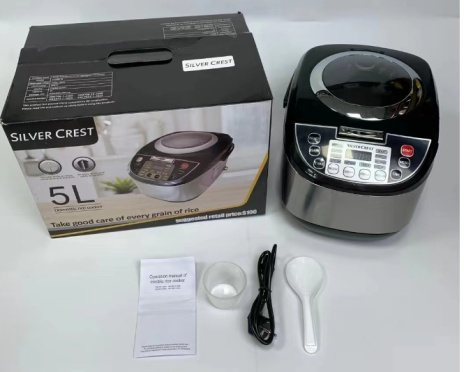
The page text fields show 5L, 900W, AC220-240V, Plastic PP and a 40HQ reference of 2268, while the source packaging image displays 6L. Capacity is a disclosed conflict that requires current sample and signed-specification confirmation.
The page text fields show 5L, 900W, AC220-240V, Plastic PP and a 40HQ reference of 2048, while the source packaging image displays 700W. Wattage is a disclosed conflict that must be frozen from the current order version.
Published standard route: 5L, 900W, AC220-240V, Plastic PP and a 40HQ loading reference of 2040. Confirm the exact lid, finish and control presentation.
Published route: 5L, 900W, AC220-240V, Plastic PP plus glass and a 40HQ loading reference of 2040. Keep it separate from the standard TK-208 approval file.
Published route: 5L, 900W, AC220-240V, Plastic PP and a 40HQ loading reference of 1700. Confirm glass, lid assembly, steam path and carton protection.
The public source does not provide a model code or key specifications. Confirm the current sample, model code, supplied inner pots, electrical data and packing before price comparison.
Model 601 has a 5L text field and a 6L packaging image. TK-108 has a 900W text field and a 700W packaging image. These values are not silently reconciled. Request the current sample, rated label, packing image and signed specification before quotation comparison or artwork release.
Pressure cookers and low-sugar rice cookers remain separate product families. Review the pressure cooker route or low-sugar rice cooker route only when those functions match the intended assortment. Do not use their wattage, controls, pot system or claims to describe a conventional rice cooker.
Capacity and exterior color do not define a complete rice cooker. The signed specification should identify the rated capacity, inner-pot material and finish, pot weight or construction reference where agreed, heating plate, thermostat or control direction, cooking and keep-warm controls, indicator lights or display, lid type, steam vent, condensation collection, handle, feet, cord, plug, supplied cup and spoon, manual, label and packing. If a feature is not published, it remains a confirmation item.
For a dual-inner-pot route, record both pots separately and state which pot is installed, nested or packed as an accessory. For a window-lid route, confirm the glass, fixing, vent and packing protection. For visually similar TK-208 routes, keep the standard and gold-stamped versions under separate revision names so artwork, samples and inspection photos cannot be mixed.
A component or material change after sample approval should enter the component change approval process. Record the old reference, proposed reference, reason, affected function, sample or evidence required, buyer decision and effective batch. No verbal substitution should silently redefine a repeat order.
A public exterior-material field such as Plastic PP does not describe the complete food-contact system. The Colombia order file should separately identify the inner-pot body, coating or finish, lid contact parts, steam vent, seal or gasket where applicable, supplied cup, supplied spoon and any other part that can contact rice, water, steam or condensation during intended use. Record the supplier document, test report or declaration requested for each relevant material and tie it to the exact model and revision.
Colombia's INVIMA Resolution 683 information page describes sanitary requirements for materials, objects, containers and equipment that contact food and beverages. It also covers import and commercialization within its stated scope. The importer and qualified Colombian advisers must decide how the rule applies to the exact cooker and which evidence is acceptable. Yaoyuan can organize available factory-side material declarations, component lists and model-specific test files, but does not declare destination approval on the buyer's behalf.
Do not reuse a report from another pot, coating, lid or model without a documented match. Do not convert a supplier statement into a broader safety or certification claim. If the current evidence does not identify the exact component or revision, keep the point open in the RFQ and resolve it before artwork, production or destination filing.
Start with the exact product construction and intended use, then ask the importing company or customs adviser to determine the proposed tariff classification. The official DIAN tariff consultation supports searches by subheading, nomenclature, measure and text. Yaoyuan can provide the model description, heating method, capacity, materials, electrical identity, accessories and packing data needed for review; the qualified Colombian party remains responsible for classification, duty, tax and customs treatment.
The official VUCE import-services page states that its import module processes registrations and licences for goods subject to prior requirements, permits or authorizations. That does not mean every rice cooker automatically follows the same filing route. The importer should check whether the proposed classification, components, material-contact scope or destination rules trigger a registration, licence, prior authorization or other review.
Keep separate decision lines for tariff classification, VUCE or prior-authorization scope, food-contact material evidence, electrical or technical requirements, Spanish consumer information, importer identity, customs valuation, taxes and destination clearance. A factory quotation is commercial evidence; it is not a Colombian customs or market authorization.
The public conventional routes above show AC220-240V. This does not establish the correct frequency, plug, cord, thermal protection, rated label or destination suitability. Send the required electrical identity before sample approval. The current sample, product label, individual box, manual, inspection file and quotation should all describe the same version.
If another voltage, frequency or plug is required, request written confirmation of model availability rather than assuming that a catalog body can be converted. The approved sample should carry the intended cord, plug and label. Any fuse, thermal cutoff, control board or heating-plate change should be included in the component and inspection file where relevant.
Use the purchase-order checklist and supplier onboarding checklist to keep the product and commercial files aligned.
OEM scope may include the product logo, control labels, rated label, warnings, model reference, barcode, importer or distributor details, manual, individual box and master-carton marks. The buyer provides accurate destination text, legal claims, barcode and importer information. The factory should not invent certification marks, cooking claims, warranty language or third-party details.
Keep the Colombian Spanish artwork as a controlled file. The product label, manual, individual box and master carton should use the approved product name, model, capacity, rated identity, supplied contents, importer or distributor information, barcode, warnings, use and cleaning text, and revision reference where required by the buyer's qualified local review. Use the OEM rice cooker service route and artwork approval workflow to align all printed files. Printed evidence should be compared with the final released artwork, not an earlier chat attachment.
Artwork should begin after the product and electrical route are sufficiently stable. A box approved around the wrong lid, pot, control panel or plug creates rework and confuses destination receiving. Keep a release register showing which files are approved, pending or superseded.
The sample file should identify the route, model code, revision, capacity, inner pot, lid, controls, cooking and keep-warm direction, electrical version, plug, cord, accessories, labels, artwork and packing. Photograph the complete supplied set and identifying details. The buyer should record accepted differences and unresolved points before any production release.
A written inspection scope can cover identity, appearance, pot fit and removal, supplied accessories, lid closure, hinge, vent and condensation parts, switches or controls, indicator response, plug and cord, label, assembly, stability, carton marks, barcode, individual box and master carton. A functional protocol can define the water-and-rice method, observation period, cooking-cycle response, transition to keep-warm, steam path, leakage or abnormal condensation observations and post-test condition. Test method, sample size and acceptance criteria must match the exact order. Generic factory activity does not prove every product version or a guaranteed cooking result.
Use the sample order guide, pre-shipment inspection control, AQL sampling guide and supplier evidence pack. Review the factory proof system, customer order evidence journey and container loading process as evidence of real operations, while keeping product approval tied to the specific order.
A unit quotation is only one part of the buyer's landed-cost file. Compare the same product revision, individual packing, units per carton, master-carton dimensions, net and gross weight, quantity, inspection, inland handling, freight basis, destination charges, qualified duty and tax input, local delivery, finance and after-sales reserve. Published loading references should be recalculated when the carton, model mix or loading method changes.
Model 601, TK-108, both TK-208 directions and S-100 publish different 40HQ references even though each public page shows 5L, 900W and AC220-240V. That difference is exactly why buyers should not estimate container quantity from capacity alone. Request the current packing sheet, then use the carton data and CBM route, mixed-container loading route and landed-cost and cooperation guide.
Freeze the current individual-box size, units per carton, carton dimensions, net weight, gross weight, protection method and any pallet or display requirement before comparing freight. No page can guarantee customs treatment, freight cost, arrival date or destination charges. These inputs require current quotations and qualified destination review. Keep assumptions dated so a buyer can see when freight, tax or handling information must be refreshed.
The buyer should provide the destination city or sales region, target selling window and the date stock must be available in the local warehouse. Work backward through destination receiving, customs and inland handling, current ocean or multimodal routing, cargo handoff, loading, inspection, packing, production, sample approval, artwork release and purchase-order release. This is a planning baseline, not a guaranteed vessel, customs clearance or arrival date.
Assign an owner and decision deadline to each approval. Product route, plug, label, manual and carton cannot remain open indefinitely without consuming the transport calendar. For a first order, preserve more time for sample and artwork decisions. For a repeat order, compare the new written revision against the previously approved sample rather than relying only on the old model name.
Use the demand and capacity planning route, production timing guide, shipment instruction route and order risk register. The buyer can then decide whether the schedule supports the commercial window before committing artwork or quantity.
At destination, reconcile container or shipment identity, seal where applicable, carton count, visible condition and sampled product identity before distribution. Check the current pot, lid, accessories, rated label and packing revision against the approved receiving file. Record transit damage, missing accessories, label issues and observed functional findings with photos, quantities and carton references. Separate transport damage from product findings so responsibility and corrective action can be reviewed accurately.
Before reordering, compare sellable units, verified service cases, returned reasons, remaining inventory, channel performance and the next warehouse-ready date. Freeze the repeat-order product, components, electrical version, artwork, carton and inspection file. Use the destination receiving guide, after-sales control route, repeat-order version control and supplier review framework.
A strategic factory relationship depends on comparable evidence, decisions and responsibilities. It does not remove the buyer's need to validate market fit, local requirements, selling price or commercial risk.
Public prices are not displayed because model route, inner pot, lid, controls, electrical version, OEM work, packing, inspection, quantity, trade term and destination change the quotation basis. Send one complete request so the sales team can prepare a comparable scope and identify open decisions.
Use COLOMBIARICE1000 in your WhatsApp message. Wholesale only. MOQ starts from 1000 PCS. No public prices, retail orders or one-piece orders.
No blanket destination approval is claimed. The importer and qualified Colombian parties must review the exact model, classification, materials, electrical identity, evidence and intended channel.
No. It is a public material field and does not define the inner-pot body, coating, lid contact parts or every food-contact component.
No. Lid, finish, accessories, source conflicts, carton references and approval files differ. Compare the exact route and current sample.
No. They are catalog references. Confirm the approved carton, units per carton, order mix, loading method and container plan.
OEM packing can be discussed. The buyer supplies and approves accurate destination text, barcode and importer information before printing.
No. Private quotation follows confirmation of route, quantity, product version, OEM scope, packing, timing, trade term and destination inputs.
Wholesale Only
MOQ starts from 1000 PCS. Exact model mix, colors, packing and OEM scope require current confirmation.
Freeze model, pot, lid, controls, electrical version, accessories, artwork, carton and inspection under one revision.
Send destination, language, importer information, sales channel, warehouse-ready date and destination port.
Price is prepared after route, quantity, product version, OEM scope, timing, trade term and destination inputs are fixed.
Long-Term Market Development
Use this route when your team can share channel evidence, target landed-cost logic, inventory and service constraints, and a repeat-order plan. Yaoyuan can coordinate the selected rice cooker version, OEM files, supplier resources, inspection and replenishment decisions. Demand, exclusivity, delivery, sales volume and margin are not promised before both parties review the evidence and responsibilities.