Importers
For Chilean companies controlling RUT or importer identity, SEC route, customs inputs and destination release.
Chile Blender Import Control File
Select one exact blender configuration, freeze the Chile electrical identity and intended food load, map the order to the current SEC protocol and authorized certification route, approve Chilean Spanish files, inspect the same production revision and preserve spare-parts traceability. Wholesale only. MOQ starts from 1000 PCS.
Qualified Buyers
For Chilean companies controlling RUT or importer identity, SEC route, customs inputs and destination release.
For buyers matching motor, jar, accessories, packing and service parts to a dealer or regional wholesale network.
For purchasing teams requiring Chilean Spanish files, barcodes, importer information and repeat-order controls.
For brand owners approving exact product construction, artwork, consumer claims, inspection and traceability.
Price depends on model, quantity, electrical identity, SEC evidence route, OEM scope, packing, inspection and trade term.
MOQ starts from 1000 PCS. No retail orders, public consumer prices or one-piece shipments.
A decision-ready Chile blender quotation identifies the importing company, RUT or importer identity, sales channel, exact model, quantity, intended foods, maximum batch, operating and rest cycle, voltage, frequency, plug, cord, motor and protection route, jar and accessories, Chilean Spanish files, destination port, trade term, SEC questions, inspection plan and service-parts boundary.
Yaoyuan Electric can coordinate available factory-side samples, specifications, component records, artwork, packing, production, inspection and cargo data. The importer and qualified Chilean parties own classification, current SEC scope, authorized certification route, customs, valuation, tax, consumer information and final market release. A public catalog record or overseas certificate does not by itself establish Chile authorization.
Published capacity, wattage, voltage, material and carton fields support product discovery only. Confirm the current sample, signed specification, model revision, rated label, exact jar set, packing and evidence file before purchase. Electrical wattage does not prove ingredient performance, duty cycle, noise, durability or suitability for a buyer's channel.
Published direction: 2.5L, 350W and AC220-240V. Confirm both cups, lids, blade assemblies, coupling identity, material contact map, Chile electrical version and current carton revision.
Published direction: 3.5L, 800W and AC220-240V. Name all three functions and supplied parts, then freeze the motor, overload protection, controls, jar set and operating test.
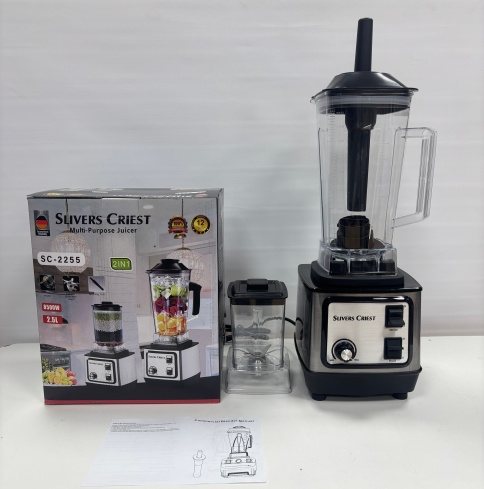
Published direction: 3L, 800W and AC220-240V, with PC, PET, PP and 201 stainless steel listed. Define every included part and food-contact surface before evidence review.
Published direction: 2L, 2400W and AC220-240V with stainless steel and PC fields. Treat the rating as catalog data, then test the intended foods and duty cycle on the approved sample.
High-speed discovery direction with incomplete public electrical and carton fields. Obtain a current motor, protection, jar, control, rating and packing specification before commercial comparison.
Compare single-jar, dual-cup, multifunction, juicer and high-speed directions. Exclude any route whose current technical or commercial identity remains incomplete.
State the required voltage, frequency, plug, cord, rated label, motor, controls, switch or PCB, thermal or overload protection, interlock where present and insulation construction in the RFQ. Published AC220-240V data is not a complete Chile order version. The approved sample, signed specification, evidence file, Spanish artwork and inspection checklist must describe one construction.
A plug change alone does not create a destination-compliant product. Changes to the motor, protection device, PCB, cord, plug, enclosure or jar interlock can affect test evidence and inspection. Use a written change record after sample approval and reopen the responsible technical review before a revised unit enters production.
Chile's SEC publishes Protocol PE No. 1/11:2021 for kitchen machines. Its listed products include mixers, juicers, food blenders, liquid blenders, food processors and related appliances, with IEC 60335-1 and IEC 60335-2-14 reference standards. The importer and SEC-authorized parties should determine the exact product name, protocol scope, certification system, required samples and applicable tests for the proposed model.
Do not rely on a generic CE statement, a report for another motor base or a certificate that does not identify the ordered construction. The protocol route, authorized certification body, testing laboratory, tested model and production revision must be reconciled. The factory can organize available documents and samples; it cannot issue Chile authorization or decide the importer’s legal route.
SEC explains that regulated products must be certified under an authorized system before commercialization and carry the applicable SEC certification mark. Available systems include type testing with follow-up, factory-quality evaluation with surveillance, lot testing, 100-percent testing and a foreign-certificate recognition system. Applicability depends on the exact product, protocol, production and importer plan.
Under lot certification, an authorized certification body extracts samples and the laboratory performs protocol tests before the body evaluates conformity. Under the foreign-certificate recognition system, SEC still requires an authorized Chilean certification body and matching protocol. Plan sample availability, document identity, destructive testing where applicable, lot control and release timing before cargo is treated as ready to ship.
Before production scheduling, identify the Chile applicant, authorized certification body, selected system, required technical file, number and condition of samples, test location, expected decision points and responsibility for failed samples or corrective work. Separate certification samples from buyer approval samples unless the authorized body accepts the same controlled units for both purposes.
Do not treat finished production as automatically releasable cargo. Define which certificate, approval record, SEC mark data, buyer inspection and commercial documents must exist before printing, packing, loading or shipment authorization. Record who can release each stage. This sequence protects the importer from discovering a certification or marking gap only after the full lot has been packed.
The SEC mark should be applied only through the authorized route and to the approved product or lot. Do not place a copied QR code, certificate number, efficiency label or SEC claim into artwork while the legal basis is unresolved. The buyer and authorized Chilean parties should confirm the exact mark, placement, linked record and release conditions.
Prepare product name, brand, model, approved rating information, warnings, instructions, barcode, buyer-supplied importer details, color box, manual, product label and master-carton marks as one controlled Chilean Spanish file set. Record filenames, revisions, approvers and dates. Compare printed samples with the approved files before mass printing and again during inspection.
Before sample testing, identify target foods, maximum batch, liquid level, ingredient size, operating time, rest interval and expected daily cycle. A blender tested with water or soft fruit does not establish performance for ice, nuts, dry ingredients or dense mixtures. Use the buyer's commercial use case to create a repeatable protocol and acceptance record.
List every food-contact component separately: jar, lid, gasket, blade, shaft, cup, mill or grinding accessory. Record material declarations, available reports, color or formulation boundaries, supplier and revision. Do not describe one general plastic report as proof for every component. Product safety certification and food-contact evidence answer different questions and should remain separate in the project file.
The private factory quote should identify the exact model, quantity, electrical construction, jar and accessory set, OEM work, packing, inspection, current carton dimensions, weights, units per carton and EXW or FOB basis. A lower price may represent a different motor, protection route, jar material, component set, certification support or carton.
The Chile importer should separately calculate freight, insurance where applicable, destination handling, SEC certification work, customs duty and taxes assessed by qualified parties, broker charges, local transport, finance, storage, spare parts and after-sales reserve. ChileAtiende states that customs duty is paid after the import declaration is prepared and validated by the National Customs Service. Use current local advice for classification, valuation and payment.
Define inspection before production finishes. Check purchase-order identity, model, quantity, motor, protection, controls, interlock where present, voltage, frequency, plug, cord, rated label, jar, lid, gasket, blade, coupling, accessories, Chilean Spanish files, barcode, box, carton marks and packing quantity. Repeat the approved ingredient protocol where practical and record leakage, overheating, odor, vibration and abnormal coupling wear.
Link the type sample or lot sample, certification record, buyer-approved sample, critical-component list, artwork, inspection and packed shipment to one traceable revision. Agree which jars, lids, gaskets, blades, couplings, switches, boards or motor assemblies will support after-sales service. Similar-looking parts are not automatically interchangeable.
Use CHILEBLENDER1000 in WhatsApp or the formal quotation form. It identifies the controlled Chile blender route. Wholesale only. No public prices or retail orders.
No blanket approval claim is made. The importer and SEC-authorized parties must confirm the exact protocol and certification route.
The published protocol lists food and liquid blenders among kitchen machines. Exact classification, current applicability and tests require authorized Chile review.
Do not assume it can. SEC has a recognition system, but it still involves an authorized Chilean certification body and matching protocol.
Yes, after the buyer approves the controlled manual, labels, warnings, barcode, importer information, box and carton files.
No. Define intended foods and duty cycle, then approve the exact sample and repeatable test protocol.
The B2B quote depends on exact construction, quantity, certification support, OEM files, packing, inspection, destination and trade term.
Wholesale Only
Importers, distributors, wholesalers, supermarket buyers and private-label brands. MOQ starts from 1000 PCS.
Product construction, SEC route, Spanish files, inspection and shipment records must identify one approved revision.
Send the complete RFQ before comparing price. Retail, one-piece orders and public consumer prices are not supported.
Long-Term Market Development
Use this route when your team can share channel evidence, target landed-cost logic, inventory and service constraints, and a repeat-order plan. Yaoyuan can coordinate the selected blender / juicer version, OEM files, supplier resources, inspection and replenishment decisions. Demand, exclusivity, delivery, sales volume and margin are not promised before both parties review the evidence and responsibilities.