Importers of Record
For buyers controlling customs entry, applicable CPSC certification and eFiling, origin marking and product traceability.
USA Electric Fan Importer Project
Do not relabel an AC220-240V catalog fan for the United States. Establish one separate 120V/60Hz motor, plug, cord, guard, control and protection construction; determine CPSC certificate and eFiling scope; separate FCC and channel evidence; approve English OEM files; and inspect the same batch revision. Wholesale only. MOQ starts from 1000 PCS.
Qualified U.S. Buyers
For buyers controlling customs entry, applicable CPSC certification and eFiling, origin marking and product traceability.
For companies assigning a defined entry, core or differentiated fan SKU to wholesale and dealer channels.
For purchasing teams that specify electrical listing, packaging, warnings, barcode, test and supplier-document requirements.
For brand owners prepared to approve a U.S.-specific construction, evidence boundary, English artwork and batch inspection.
Price depends on engineering, quantity, evidence support, OEM files, packing, inspection, destination and trade term.
MOQ starts from 1000 PCS. No public consumer price, retail order or one-piece shipment.
The public catalog supports appearance and format screening, but most listed fan models identify AC220-240V or 220V directions. They are not production-ready U.S. products. A U.S. RFQ should define the importing company, importer of record, sales states and channels, intended use, exact fan model, quantity, target 120V/60Hz rating, motor, blade, guard, oscillation, stand or base, plug, cord, control type, digital or wireless functions, retailer or listing requirements, English OEM files, first-sale date, destination port and inspection scope.
Yaoyuan can coordinate available factory-side samples, specifications, component records, artwork, packing, production, inspection and shipment data. The U.S. importer and qualified U.S. parties determine CPSC rule and certificate scope, eFiling, FCC authorization, NRTL or channel acceptance, customs, state obligations, consumer information and market release. The factory does not issue U.S. approval or act as importer of record.
These records are discovery routes, not finished U.S. SKUs. Confirm whether a 120V/60Hz motor, cord, plug, controls and protection system can be developed for the selected platform. The current sample, signed specification, critical-component file, labels and inspection plan must all describe the proposed U.S. revision.
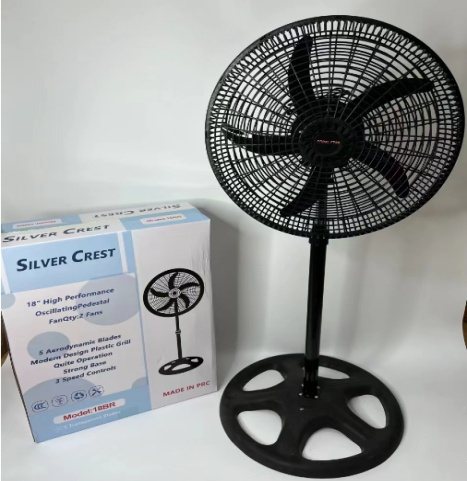
Published as AC220-240V, PP 18-inch construction, two units per carton and a 40HQ reference of 2600. The U.S. project must separately confirm motor, current, controls, plug, cord, stability, carton and evidence.
Catalog reference without a confirmed public model code. Public fields include AC220-240V and PP 18-inch construction. Define every supplied configuration, mounting part, motor, base, control and carton.
Separate catalog route with AC220-240V and PP 18-inch references. It cannot inherit the 18BR or P55 U.S. construction, testing or service-parts identity without a controlled comparison.
Catalog reference without a confirmed public model code. Public fields include AC220-240V, plastic construction, two units per carton and a 40HQ reference of 2600. Freeze the actual supplied set and U.S. engineering path.
Published as 220V, 50-60Hz and 30W with two units per carton. The current panel, battery, charger, protection, transport records and 120V interface must be obtained before treating it as a U.S. program.
Compare standing, 3-in-1 and solar directions. Remove any route whose U.S. engineering, supplied parts, packing or evidence boundary cannot be defined.
These links identify current public catalog records only. None proves a released U.S. 120V/60Hz fan, CPSC or FCC scope, listing, state acceptance, battery transport readiness, stock or timing. Select the record first, then verify the complete U.S. revision.
A voltage field does not define the motor winding, current, plug, cord, switch, capacitor, controller, grounding or insulation system. The U.S. specification should state the rated voltage and frequency, input power and current, electrical class, motor and capacitor identity, plug configuration, cord type and length, switch or controller, protection devices, critical components and measured performance of the approved sample.
Changing only the plug or nameplate can create an unsafe and untraceable product. A 120V fan can require different winding, conductor, contact, protection and thermal decisions from its 220-240V catalog direction. Use one approved sample, schematic or wiring record, bill of materials, rating label and inspection standard. Reopen the review when a critical component or manufacturing process changes.
Fan size alone does not describe a saleable SKU. Record motor type and rating, speed positions, blade count and material, guard spacing and fastening, oscillation range, tilt, height or mounting range, stand or base, center of gravity, switch or remote system, supplied hardware, assembly instructions, cord routing and carton protection.
Inspection should check starting, speed change, airflow response, abnormal noise, vibration, oscillation, guard fixing, blade clearance, control operation, stability and safe assembly. The buyer should define test conditions and sampling before production finishes. A general factory video can support supplier verification, but it cannot replace batch-specific inspection.
CPSC states that a General Certificate of Conformity is required for a general-use product when that product is subject to a CPSC-enforced rule, ban, standard or regulation that requires certification. A GCC is likely not required when no listed certification rule applies. The U.S. importer remains responsible for identifying applicable rules and issuing an accurate certificate when required; a supplier should not automatically create a GCC for every fan.
Beginning July 8, 2026, importers of regulated consumer products subject to CPSC certification requirements must electronically file certificate data before entry into U.S. commerce. The importer should connect the product identifier, manufacturer, place and date of manufacture, testing information, applicable rules and shipment to the same physical revision. A model mismatch between test record, certificate, carton and customs entry weakens the file.
A simple mechanical fan, a fan with clocked digital circuitry and a fan with Wi-Fi, Bluetooth or radio remote functions can present different FCC questions. The importer should classify the finished configuration and identify the applicable authorization route, test evidence, U.S. responsible party, label and user-information requirements before artwork approval.
Do not copy an FCC ID from a module or remote component and assume it authorizes every finished fan. Host enclosure, antenna, firmware, power, separation, module grant conditions and user instructions can affect the final route. Any PCB, display, module, antenna, power-supply or firmware change should trigger a documented FCC review.
UL is not one universal federal customs requirement for every portable household fan. OSHA's NRTL program recognizes private organizations to certify products within their scopes for relevant workplace electrical requirements. Retailers, marketplaces, insurers, institutional buyers and local authorities can separately require a recognized safety listing or particular standard.
The buyer should state the sales channel, intended environment, requested mark, applicable product standard, certification owner, factory authorization and follow-up requirements before laboratory work begins. Do not print UL, ETL or another certification mark unless the exact product, factory and label use are authorized. A test report and an active listing are not interchangeable records.
Prepare the brand, controlled model, rated label, warnings, assembly instructions, manual, barcode, individual box and master carton as one approved English file set. Add importer, certification, FCC or state information only after the responsible party confirms the required text and evidence. Claims about airflow, quiet operation, energy use, battery duration or performance should be supported by the exact sample and defined method.
CBP generally requires imported foreign articles to identify the English country of origin conspicuously, legibly and permanently, subject to applicable exceptions. Approve the "Made in China" placement on the product and packaging before production. Keep country-of-origin, brand, model and carton identity consistent with the commercial and customs records.
A catalog description using the word solar does not confirm the supplied panel, battery chemistry, capacity, charger, protection board, runtime, transport classification or U.S. electrical interface. Request the current component list and sample before quoting claims. Battery and transport questions should be assigned to qualified parties using the exact cell, pack and shipment mode.
Do not combine a conventional AC fan and a rechargeable or solar fan under one test, listing, label or service-parts assumption. Their power paths, charging risks, accessories, transport records and post-market support can be different. Use separate model identities and approval records unless the responsible evidence explicitly covers the family.
The factory quotation should identify the exact construction, quantity, engineering status, evidence support, OEM scope, packing, inspection and trade term. The importer should separately calculate freight, insurance where applicable, duties, fees, broker costs, port and inland movement, storage, finance, retailer allowances, returns, warranty and service-parts reserve.
A catalog 40HQ figure does not guarantee loading. Recalculate the approved carton, route mix, master-carton orientation, pallets if required, loading constraints and sample or spare-part cartons. Work backward from the required warehouse or first-sale date through destination receiving, customs, transport, loading, inspection, production, testing, artwork and sample approval. Do not advertise a delivery date until the order schedule and booking are confirmed.
Pre-shipment inspection should verify purchase-order identity, model, quantity, 120V/60Hz construction, motor and capacitor, plug and cord, controls, blade, guard, oscillation, stability, labels, English artwork, origin marking, accessories, barcode, carton marks and sampling criteria. Record test conditions, findings, accepted deviations and responsible approvals.
Maintain a batch link among the approved sample, component revision, evidence, artwork and shipment. For repeat orders, compare the bill of materials and files with the previously accepted version. Material changes to the motor, capacitor, cord, plug, PCB, wireless module, blade, guard or base can reopen safety, FCC, listing, performance and service-parts decisions.
Use USAFAN1000 in WhatsApp or the formal quotation form. It identifies the controlled U.S. fan development route. Wholesale only. No public prices or retail orders.
No. The U.S. project needs a separately controlled 120V/60Hz motor, plug, cord, controls, protection, label, sample and evidence route.
Not automatically. The U.S. importer should determine whether the exact fan is subject to a CPSC-enforced rule requiring certification.
No. The route depends on the finished mechanical, digital or radio configuration. Wireless functions generally create different authorization questions.
No universal claim is made. Confirm retailer, workplace, insurer, local and buyer requirements, then identify the exact recognized mark and product standard.
The importer owns applicable U.S. certificate and eFiling duties. Yaoyuan can coordinate accurate factory-side data and evidence for the approved model.
The B2B quote depends on engineering, construction, quantity, evidence support, OEM files, packing, timing, inspection, destination and trade term.
Wholesale USA Project
U.S. importers, distributors, wholesalers, retail buyers and private-label brands. MOQ starts from 1000 PCS.
CPSC, eFiling, FCC, listing, origin marking, state obligations and market release remain with qualified U.S. owners.
Engineering, sample, evidence support, English files, production, inspection and shipment data must identify one revision.
Version Evidence Before Quotation
Identify the exact model or catalog reference first. Yaoyuan can organize available sample, specification, packing and inspection evidence for that controlled version. The importer and qualified destination-market parties remain responsible for confirming applicable market-access, customs and channel requirements. This review does not promise certification, stock, delivery timing, demand, sales or profit.