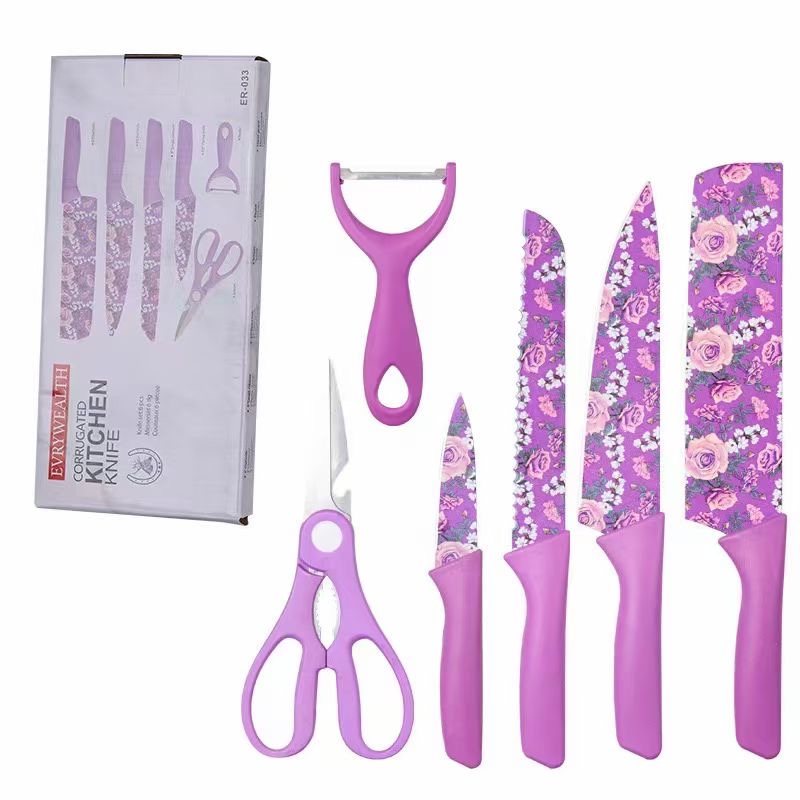
Six-piece direction
Printed Color Box
Published packing: 48 sets/CTN; 545 x 335 x 495mm master-carton reference. Exact pieces, blade and handle construction, unit packing and weights remain approval items.
Brazil Strategic Wholesale Partner | Five Source-Catalog Routes
This route is for Brazilian importers, kitchenware distributors, supermarket buyers, online sellers with bulk demand, promotional-program buyers and private-label brands that need more than a set-count and a product image. It connects the selected physical set, blade and handle evidence, Portuguese retail files, protective packing, landed cost, inspection, service feedback and repeat-order identity.
The source catalog presents five visibly different directions: printed color-box six-piece, wheat-straw color-box six-piece, marble-pattern seven-piece, wave-pattern color-box six-piece and acrylic chubby-handle seven-piece sets. It publishes route-specific carton references and quantities per carton. It does not publish a reliable model number, complete piece list, blade grade, edge geometry, coating, handle construction, accessory identity, unit dimensions, weights, verified food-contact evidence, durability or Brazilian market-release status.
Wholesale only. MOQ starts from 1000 sets. No retail or one-piece orders. Public prices are not displayed. A private quotation begins only after the route, exact pieces, current sample, material map, Portuguese OEM files, final packing, destination and inspection scope are aligned.
Direct Buyer Answer
Compare exact set identity, piece list, blade and handle construction, material evidence, dimensions, finish, sharp-edge and use checks, Portuguese warnings, individual packing and master carton. Similar appearance or broad material wording cannot close those fields. The importer defines channel, responsible local review and destination treatment; Yaoyuan can coordinate current samples, component clarification, OEM files and inspection. MOQ starts from 1000 sets, and each private quotation must stay tied to one verified set and packing revision.
Five Route Boundaries
Six-piece direction
Published packing: 48 sets/CTN; 545 x 335 x 495mm master-carton reference. Exact pieces, blade and handle construction, unit packing and weights remain approval items.
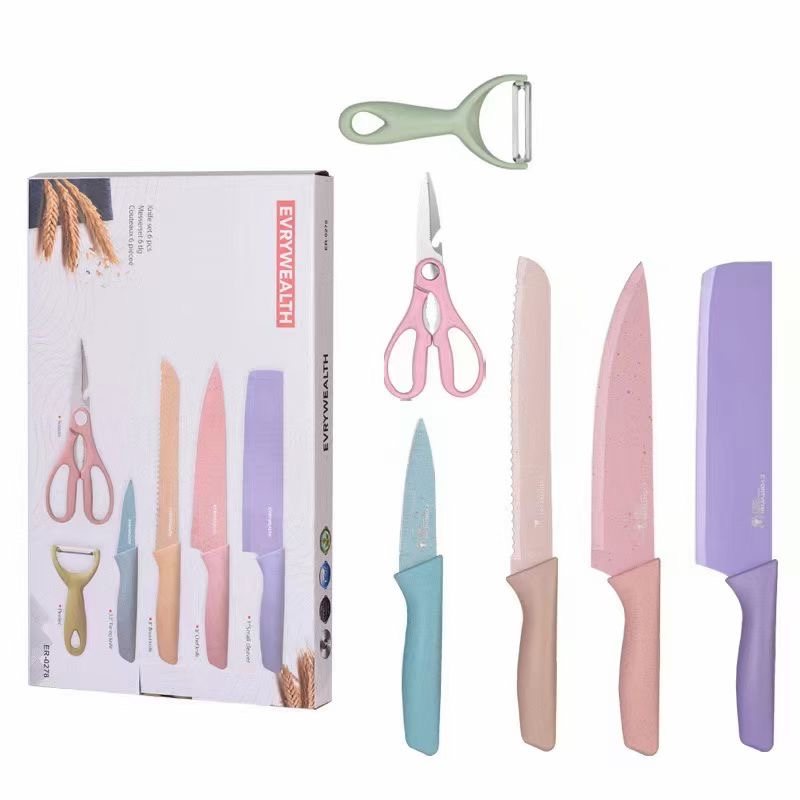
Six-piece direction
Published packing: 48 sets/CTN; 435 x 310 x 418mm master-carton reference. The route name does not prove the composition of every handle, stand or accessory.
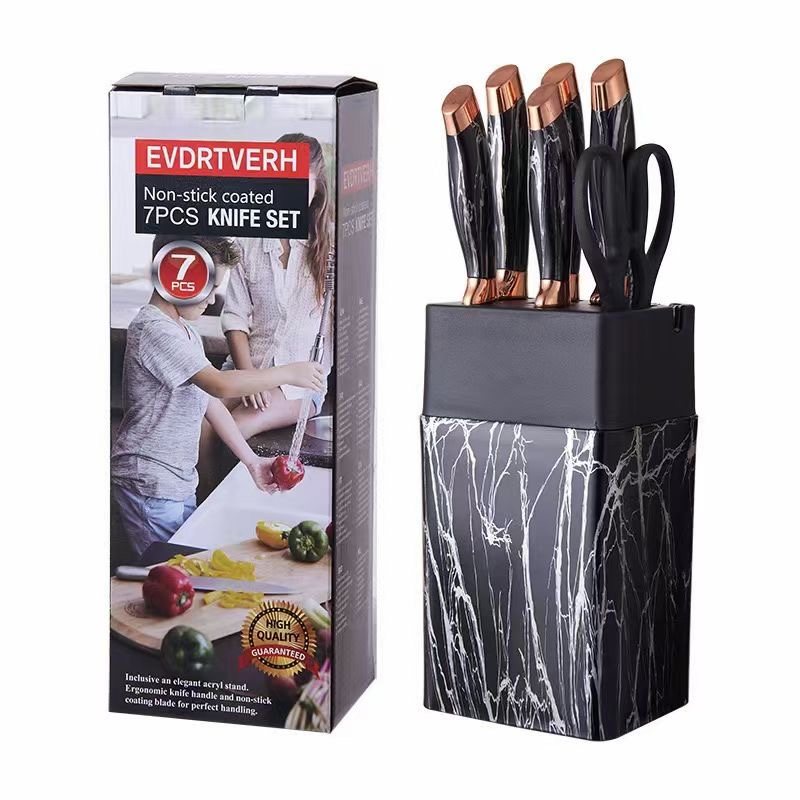
Seven-piece direction
Published packing: 12 sets/CTN; 710 x 533 x 392mm master-carton reference. The larger carton route needs exact piece arrangement and final freight inputs.
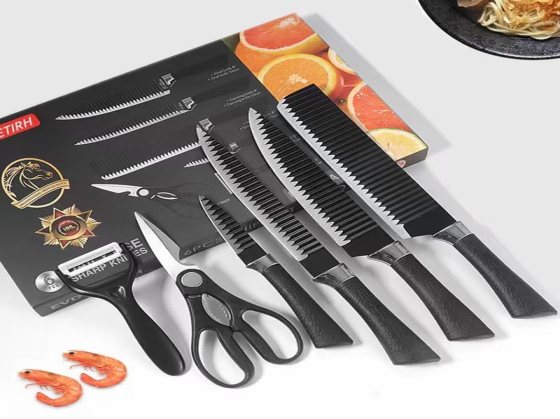
Six-piece direction
Published packing: 30 sets/CTN; 665 x 375 x 315mm master-carton reference. Surface appearance must be tied to the current sample and finish controls.
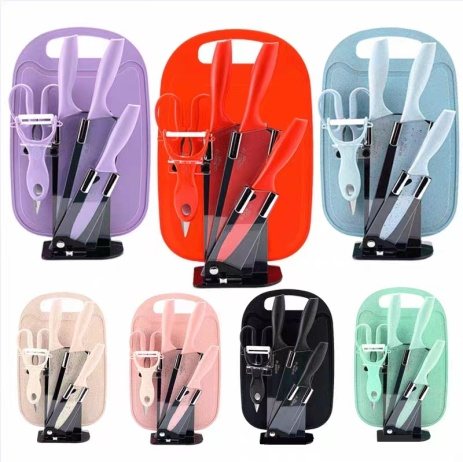
Seven-piece direction
Published packing: 20 sets/CTN; 575 x 480 x 685mm master-carton reference. Handle material, joining method, blade identity and exact accessories still require a current BOM.
Source Accuracy
Several source rows use a broad food-grade silicone plus stainless-steel phrase for knife sets. That wording does not identify blade steel, coating, handle body, joining material, stand, scissors, peeler, protective sleeve or any other included part. The current BOM must separate each component and its claimed material.
The five routes do not provide a reliable model number. Assign a controlled project reference after the buyer selects the route and current sample. Put that reference on quotation, sample record, artwork, inspection, packing list, complaint record and repeat order so a photo does not become the only identity.
Six pieces or seven pieces does not reveal which knife profiles, scissors, peeler, sharpener, stand or other accessories are included. Name every piece by function and quantity, then record dimensions and material expectations. A missing or substituted accessory changes the sale unit even when the printed set count remains unchanged.
The carton references and quantities differ substantially across appearances. Do not copy one set's carton, CBM, weight or loading assumption into another. Use the complete approved sale unit to confirm final carton dimensions, quantities, weights, protective arrangement and pallet policy before freight planning.
Strategic Resource Exchange
Company and importer identity, state or sales region, actual channels, competitor sets, target customer and commercial position, shelf or online presentation requirements, landed-cost inputs, Portuguese reviewers, customs and product specialists, service capacity, launch forecast, stock plan and sell-through evidence.
Available product and supplier routes, current samples, component and material clarification, piece-list control, OEM files, packing development, production coordination, inspection, shipment evidence, mixed-container planning and replenishment review.
Food-contact conformity, customs treatment, product safety status, blade performance, durability, delivery date, duty, demand, retailer acceptance, margin, sales or profit. Each decision needs a named owner, current evidence and a dated review.
Begin with one or two clearly differentiated routes rather than five similar sets without a channel role. Expand colors, piece configurations, OEM investment, quantities or territory only after incoming quality, stock age, dealer feedback, service cases, sell-through and reorder evidence support the next commitment.
Assortment Architecture
An entry route should have a clearly defined piece list, understandable packaging and a landed cost suitable for its actual dealer or supermarket position. Entry does not mean unverified steel, weak packing or copied claims. The partner should know which competing set it replaces and why its configuration is sufficient for that customer.
Marble, wave or acrylic-handle appearances can support visual differentiation, but the buyer must approve pattern consistency, color tolerance, surface finish, handle joins and display presentation. A design name does not establish material or durability. Use current samples and production references to keep the visual promise repeatable.
A gift program may require logo placement, message card, sleeve, recipient presentation, delivery allocation and client-specific carton marks. Confirm the approval chain, final set, packing and timing before quoting a finished program. Promotional intent does not prove seasonal demand or a fixed outcome.
A brand's core set should have stable component identity, controlled materials, useful piece logic, Portuguese instructions, service identification and a reorder code. The buyer should invest in deeper artwork or exclusivity only after the selected route's quality, channel fit and replenishment evidence support that commitment.
Online sellers need accurate piece-by-piece images, dimensions, materials, cleaning guidance, controlled feature statements and service answers. The listing should use the approved sample and evidence set, not descriptions copied from a visually similar marketplace listing.
Knife sets can add non-electrical kitchenware beside air fryers, blenders, cookers and other approved appliances. That may diversify the assortment, but every selected set still needs a channel, final carton, cash allocation, inspection line and reorder rule. Empty container space is not a product strategy.
Current-Sample Approval
Record route name, project reference, sample date, every piece, stand or tray, protective parts, retail box and all labels. Photograph both sides of each blade, edge, tip, handle joins and accessory mechanisms. The image set should make missing, duplicated or substituted pieces observable.
Record overall length, blade length, blade width, thickness at defined points, handle length and relevant accessory dimensions. Agree tolerances only after supplier capability and intended use are reviewed. Do not assume that all knives in a set share the same thickness, material or construction.
Identify claimed blade material, surface treatment or coating, edge type, spine, tip, tang or joining route and any marking. Connect each statement to the current BOM and buyer-required evidence. A stainless-steel phrase alone does not define grade, heat treatment, corrosion behavior or edge retention.
Identify handle body, inserts, soft-touch areas, decoration, fasteners, adhesive or joining method, stand, scissors and peeler. Record color and finish references. If a wheat-straw, acrylic or silicone phrase is used, define exactly which component it describes and what evidence supports it.
The importer chooses representative cutting tasks, food types, preparation, cleaning and observation methods. Record edge condition, handle security, control, visible corrosion, coating change and accessory operation under stated conditions. A limited sample test is not proof of universal performance or lifetime.
List missing material, food-contact, safety, test, marking, packing and destination evidence. Give every gap an owner and closing condition. Do not allow box printing or sales content to turn an unclosed question into an approved fact.
Food-Contact and Claim Control
Separate blade, coating, handle, decoration, adhesive, stand, scissors, peeler and protective parts. The Brazil partner identifies which components and uses require destination evidence. The factory coordinates available BOM and supplier documents, but a broad catalog phrase is not proof for the finished set.
Anvisa explains that food-contact rules are organized by material and that substances used in authorized food-contact materials are evaluated under applicable requirements. The importer and its qualified specialist must determine the current scope for the exact components and claims. This page does not claim approval.
Official Anvisa food-contact materials guidanceSharp, ultra-sharp, professional, rustproof, non-stick, dishwasher-safe, antibacterial, ergonomic and durable are not automatic consequences of a route name or photograph. Define the property, test, conditions, samples, acceptance criteria and evidence owner before using the claim in Portuguese packaging or advertising.
Maintain claim text, language, channel, exact SKU revision, supporting file, owner, approval date and review trigger. Use the same register for box, listing, retailer submission, social video, dealer sheet and service response. Remove or revise a claim when the physical version or evidence changes.
Portuguese OEM and Safety Communication
Use the approved route, piece count, brand, set image and only verified material or feature statements. Show the complete set accurately. Do not use an attractive image containing a sharpener, scissors, peeler or stand that is absent from the packed unit.
Confirm piece list, dimensions where stated, materials where supported, cleaning and storage guidance, warning text, origin, importer or responsible-party information, barcode and service contact with qualified Brazilian reviewers. The importer owns final Portuguese and destination-market review.
Describe unpacking, intended kitchen use, stable cutting surface, safe handling, cleaning boundaries, drying, storage and inspection for damage based on the approved construction. Avoid unsupported statements about dishwasher use, child safety, maintenance-free life or suitability for every food and task.
Give box, insert, label, barcode and carton marks revision codes. Require written approval from the named Brazil reviewer. A repeat order should cite the accepted files and record every changed piece, material, image or statement before printing.
Brazil Import Decision Gate
The Brazilian importer and customs specialist determine the NCM and current administrative treatment from the exact pieces, materials, accessories and sale-unit presentation. Siscomex states that informational tables do not replace the current treatment simulator. Recheck the selected finished route before shipment.
Official Siscomex treatment guidanceUse official treatment and tax simulators after classification attributes, value and import route are defined. Never copy an NCM, licence answer, duty or tax result from a different set, one loose knife or an old shipment.
Official Siscomex simulatorsThe Brazil partner should have qualified local review for product description, materials, warnings, age or use restrictions, importer information and channel-specific obligations. Yaoyuan can coordinate available technical records and files but does not promise customs clearance, approval or retailer acceptance.
Changing a blade, handle, coating, scissors, peeler, stand, protective part or retail presentation can change the evidence and classification questions. Do not assume that an old decision automatically covers a revised set under the same visual family.
Landed Cost and Packing
Attach project reference, piece list, blade and handle construction, finish, stand and accessories, evidence scope, Portuguese files, unit packing and inspection to every quotation. Two sets with the same count can carry different material, protection and service costs.
The published carton references range from 12 to 48 sets per carton and use very different dimensions. Confirm final unit-box size, insert, sleeves, accessory protection, quantity, gross weight, net weight, carton strength, pallet policy and deformation limits before comparing freight.
The importer should include classification, material review, translation, barcode, local labeling, customs, tax, inland delivery, service reserve and professional fees in the landed-cost model. Factory price alone cannot determine the economics of a saleable Brazil unit.
Model cash tied in goods, freight, customs, local inventory, service stock and slow-moving designs. Select route depth from channel evidence and expected replenishment logic. No product page can guarantee turnover, margin or profit.
Production and Inspection
Do not release components or printing until the signed sample, piece list, BOM, dimensions, finishes, Portuguese files, barcode, carton marks and inspection checklist use the same project revision. Record approved deviations and the documents they affect.
Buyer-defined controls may cover blade profile, visible finish, edge condition, handle joins, decoration, accessory operation, stand fit and protective arrangement. Material or performance tests should follow the approved plan and evidence requirements for the exact route.
Sample completed cartons and record project identity, set count, piece identity, dimensions, appearance, edge and tip condition, handle security, accessory operation, artwork, barcode, protective packing, carton dimensions, weights and shipping marks. Inspection should state sample size and acceptance method.
Link purchase order, approved revisions, production records, inspection result, carton count, packing list and loading evidence. This pack helps the Brazil partner prepare receiving and helps both sides separate manufacture, packing, transport, storage and channel-handling questions.
Receiving and Replenishment
Record seal and carton condition, received quantity, project reference, complete set, protective packing, visible blade or handle damage, barcode, sampled dimensions and selected buyer checks. Report evidence within the agreed claim window.
Classify missing piece, edge damage, loose handle, finish variation, coating issue, accessory failure, stand fit, rust observation, packing damage or incorrect artwork. Include lot, date, photos, video, cleaning and storage context rather than sending only a general complaint.
Review stock received, stock sold, stock age, dealer reorder, returns, service cases and feedback by route, channel and region. A large opening shipment does not prove sustainable demand. Use the actual approved set's evidence for replenishment decisions.
Keep accepted pieces, materials and files stable unless the partners approve a revision. If any blade, handle, accessory, stand, color, box or claim changes, update the project identity, specification, evidence, service references and inspection checklist before production.
Decision-Ready RFQ
Send company name, importer role, Brazilian state or sales region, actual channel, target customer, competing sets, target commercial position, expected launch window and the reason this set belongs in the assortment.
Select printed, wheat-straw, marble, wave-pattern, acrylic-handle or attach another exact reference. State six or seven pieces, name every required piece, material and finish expectations, sample tests and claims planned for the market.
Send quantity, colors, logo, Portuguese files, barcode ownership, importer information, unit-packing target, destination port, trade term, shipment window, inspection scope and current customs or material-review questions.
Identify your channel evidence, competitor data, landed-cost inputs, local reviewers, service capacity, stock plan and sell-through reporting. We will identify available product, supplier, component, sample, OEM, packing, production, inspection, mixed-container and replenishment resources.
Wholesale Only
Send company, market region, channel, selected route, exact piece list, quantity, material and OEM requirements, destination, inspection and the local resources your team contributes. We will respond with the next evidence and quotation steps.