Importers of Record
For companies controlling customs entry, applicable CPSC certification and eFiling, origin marking, state review and traceability.
USA Rice Cooker Importer Project
Do not relabel an AC220-240V catalog rice cooker for the United States. Build one separate 120V/60Hz heating, control, plug, cord and protection construction; map food-contact parts; determine CPSC certificate and eFiling scope; approve English OEM files; and inspect the same production revision.
Wholesale only. MOQ starts from 1000 PCS. Public prices are not displayed.
For general model selection, branding and specification planning, visit the OEM rice cooker program. Continue below for a United States 120V project.
Qualified U.S. Buyers
For companies controlling customs entry, applicable CPSC certification and eFiling, origin marking, state review and traceability.
For buyers assigning a defined capacity, pot system, price position, service-parts plan and repeat-order construction.
For teams specifying electrical listing, food-contact documents, packaging, warnings, barcodes and supplier evidence.
For brand owners prepared to approve a U.S.-specific sample, cooking protocol, English artwork and batch inspection.
Price depends on construction, quantity, evidence support, OEM files, packing, inspection, destination and trade term.
MOQ starts from 1000 PCS. No public consumer price, retail order or one-piece shipment.
The public catalog can support format and appearance screening, but the listed conventional routes identify AC220-240V directions. They are not production-ready U.S. SKUs. A U.S. RFQ should identify the importing company, importer of record, sales states, channels, exact model, quantity, capacity, rice and use assumptions, inner pot, coating, lid, steam path, control method, accessories, target 120V/60Hz rating, plug, cord, English files, food-contact questions, buyer-specified listing or retailer requirements, first-sale date, destination port and inspection scope.
Yaoyuan can coordinate current samples, specifications, component records, available material documents, artwork, packing, production, inspection and shipment data. The U.S. importer and qualified U.S. parties determine CPSC rule and certificate scope, eFiling, FCC authorization, electrical acceptance, customs, state obligations, consumer information and market release. The factory does not issue U.S. approval or act as importer of record.
These records are discovery routes, not finished 120V U.S. products. Confirm whether a separate 120V/60Hz heater, control, cord, plug and protection system can be developed for the selected platform. The signed specification, approved sample, critical-component list, food-contact map, labels and inspection standard must all describe the proposed U.S. revision.
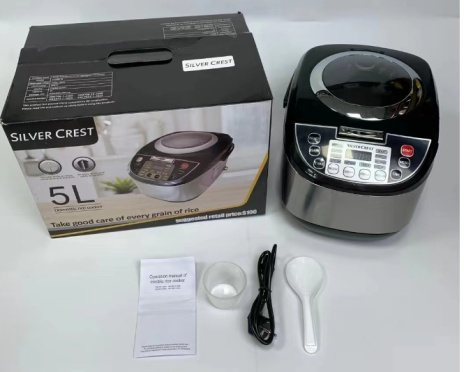
Published route: 5L, 900W, AC220-240V, Plastic PP and a 40HQ reference of 2040. Confirm pot, coating, lid, controls, 120V heater, current, protection and carton.
Published route: 5L, 900W, AC220-240V, PP plus glass and a 40HQ reference of 2040. Keep appearance, glass-lid, artwork and U.S. evidence separate from standard TK-208.
Published route: 5L, 900W, AC220-240V, Plastic PP and a 40HQ reference of 1700. Confirm glass, lid fixing, steam path, carton protection and the real 120V construction.
The route has a 5L text versus 6L packaging-image conflict. Page text also shows 900W and AC220-240V. Do not quote capacity or electrical identity until the current sample and signed specification resolve both.
The route has a 900W text versus 700W packaging-image conflict. Page text also shows 5L and AC220-240V. Freeze the rated label and bill of materials before comparison.
Catalog 40HQ numbers are references, not guarantees. Recalculate after the approved individual box, master carton, units per carton, route mix and any pallet requirement are known.
A voltage field does not define the heater, thermostat, thermal cutout, fuse, wiring, contacts, cord, plug, grounding or insulation system. The U.S. specification should state rated voltage and frequency, input power and current, electrical class, heating plate, thermostat, temperature protection, fuse, connector, cord type and length, plug configuration, control assembly, critical components and measured performance of the approved sample.
Changing only the plug or rating label can create an unsafe and untraceable product. A 120V heating product can require different conductor, contact, protection and thermal decisions from a 220-240V catalog route. Use one controlled schematic or wiring record, bill of materials, critical-component list, rated label and inspection standard. Reopen the review whenever a heater, thermostat, fuse, cord, plug, control or insulation material changes.
Capacity alone does not describe the cooking system. Record inner-pot substrate, thickness, coating layers, supplier and color; lid material and underside; steam vent, seal and condensate path; heating-plate contact; handles; measuring cup; rice paddle; detachable parts and every component that can contact rice, water or condensate. Keep drawings and material documents linked to the exact sample.
Do not infer food-contact suitability from exterior material text or a generic supplier report. A document for one resin, coating or color does not automatically cover the finished pot, migration conditions, lid, seal, spoon or production revision. The importer should define intended food types, cooking temperature, time, repeated-use conditions and evidence needed for the actual U.S. sales route.
FDA organizes food-contact reviews around the substance, food type and conditions of use. Its official reference tables distinguish aqueous, acidic, fatty and dry foods and different thermal conditions, including cooking above 250 degrees Fahrenheit. A useful rice cooker file therefore identifies each contact component, its material, supplier, intended food, maximum time and temperature, repeated-use assumption and matching regulatory or supplier evidence.
The factory can coordinate available declarations, specifications and reports when they identify the same material and revision. The U.S. importer and qualified food-contact specialists determine whether a substance is authorized for the intended use and whether the assembled product file is sufficient. Do not turn a material document into a blanket claim that the entire appliance is “FDA approved.”
CPSC states that manufacturers and importers of general-use products subject to an applicable CPSC-enforced rule, ban, standard or regulation requiring certification must issue a General Certificate of Conformity. For an overseas product, the importer is legally responsible for the GCC. When no listed certification rule applies to the exact general-use product, a GCC is likely not required. Product category alone is not enough to make the decision.
Mandatory CPSC eFiling took effect on July 8, 2026 for imported regulated consumer products subject to CPSC certification requirements. The importer should connect the product identifier, applicable rules, certifier, manufacture information, test details and shipment to the same physical revision before entry. This does not mean that every rice cooker automatically needs a GCC; it means that an applicable certificate must now be electronically filed when the product is within certification scope.
A simple mechanical switch, a clocked digital control panel and a Wi-Fi or Bluetooth rice cooker can present different FCC questions. The importer should classify the finished configuration and determine the authorization route, test evidence, U.S. responsible party, label and user-information requirements before artwork release.
Do not copy an FCC ID from a module and assume it authorizes every finished host. PCB, clock, enclosure, antenna, firmware, power, separation, module grant conditions and instructions can affect the route. Any board, display, module, antenna, power-supply or firmware change should trigger a documented FCC review. A purely mechanical route should still have its final electronics checked rather than relying on a marketing name.
UL is not one universal federal customs requirement for every household rice cooker. OSHA's NRTL program recognizes private organizations to certify products within their scopes for relevant workplace electrical requirements. Retailers, marketplaces, insurers, institutional buyers and local authorities can separately require a recognized safety listing or a particular standard for the finished appliance.
The buyer should state intended channels, use environment, requested mark, applicable product standard, certification owner, factory authorization and follow-up requirements before laboratory work begins. Do not print UL, ETL or another certification mark unless the exact product, factory and label use are authorized. A laboratory report and an active listing are not interchangeable records.
Define rice type, rice mass, water ratio, ambient conditions, starting temperature, cooking mode, cycle time, keep-warm period and acceptance observations before testing. Record switch and indicator operation, heating, automatic transition, lid and steam behavior, overflow, scorching, sticking, pot removal, handle and accessible temperatures, current draw, abnormal conditions and protection response.
Use the same approved sample and method for pre-production review, inspection and receiving comparison. If the pot, coating, heater, thermostat, fuse, control board, lid, seal, cord or plug changes, reopen affected cooking, safety, food-contact and evidence checks. A showroom demonstration cannot define a commercial order or support an unsupported performance claim.
Prepare the brand, controlled model, rated label, warnings, instructions, measuring method, accessories, barcode, individual box and master carton as one approved English file set. Add importer, certification, FCC or state information only after the responsible party confirms the required text and evidence. Capacity, non-stick, automatic safety, healthier cooking, energy-saving or performance claims should be supported by the exact sample and defined method.
CBP generally requires imported foreign articles to identify the English country of origin conspicuously, legibly and permanently, subject to applicable exceptions. Approve “Made in China” placement on the product and packaging before production. Keep country of origin, brand, model and carton identity consistent with purchase, commercial and customs records.
The factory quotation should identify the exact construction, quantity, engineering status, evidence support, OEM scope, packing, inspection and trade term. The importer should separately calculate freight, insurance where applicable, duties, fees, broker costs, port and inland movement, storage, finance, retailer allowances, returns, warranty and service-parts reserve. Factory price is only one part of the commercial decision.
Work backward from the required warehouse or first-sale date through destination receiving, customs, transport, loading, inspection, production, testing, artwork and sample approval. Recalculate loading after final carton approval. Do not advertise a delivery date, retail margin, demand level or container quantity until the responsible parties confirm the underlying order and market data.
Pre-shipment inspection should verify purchase-order identity, model, quantity, 120V/60Hz construction, heater, thermostat, protection, plug, cord, inner pot, coating, lid, steam path, controls, cooking test, labels, English files, origin marking, accessories, barcode, carton marks and agreed sampling. Record test conditions, findings, accepted deviations and responsible approvals.
Maintain a batch link among the approved sample, components, food-contact map, evidence, artwork and shipment. For repeat orders, compare the bill of materials and files with the previously accepted version. A change to the heater, thermostat, fuse, pot, coating, cord, plug, PCB, wireless module, lid or seal can reopen safety, FCC, food-contact, listing, performance and service decisions.
Use USARICE1000 in WhatsApp or the formal quotation form. It identifies the controlled U.S. rice cooker development route. Wholesale only. No public prices or retail orders.
No. The U.S. project needs a separately controlled 120V/60Hz heater, plug, cord, controls, protection, label, sample and evidence route.
Not automatically. The U.S. importer determines whether the exact product is subject to a CPSC-enforced rule requiring certification.
No. The route depends on the finished mechanical, digital or radio configuration. Wireless functions create different authorization questions.
We do not make that blanket claim. Food-contact review should identify each substance, component, intended food and condition of use.
No universal claim is made. Confirm retailer, workplace, insurer, local and buyer requirements, then define the exact recognized mark and standard.
The B2B quote depends on construction, quantity, evidence support, OEM files, packing, timing, inspection, destination and trade term.
Wholesale USA Project
U.S. importers, distributors, wholesalers, retail buyers and private-label brands. MOQ starts from 1000 PCS.
CPSC, eFiling, FCC, listing, food-contact acceptance, origin marking, state obligations and market release remain with qualified U.S. owners.
Engineering, sample, component evidence, English files, production, inspection and shipment data must identify one revision.
Version Evidence Before Quotation
Identify the exact model or catalog reference first. Yaoyuan can organize available sample, specification, packing and inspection evidence for that controlled version. The importer and qualified destination-market parties remain responsible for confirming applicable market-access, customs and channel requirements. This review does not promise certification, stock, delivery timing, demand, sales or profit.